Catering for corporate events in Limassol: what business catering actually looks like

Limacat handles corporate event catering across Limassol and the rest of Cyprus — business meetings, working lunches, conferences, presentations, product launches, team off-sites, holiday parties, and partner events, for 10 to 500 guests. We’ve been doing this since 2020, working with both one-off events and long-term corporate partnerships across the island. Catering is turnkey: we plan the menu with you, cook fresh on the day of your event, deliver to your office or venue, set up, serve through the event, and clean up at the end. Official invoices are issued for corporate clients; VAT and invoicing details are confirmed at the quote stage. To plan a corporate event, call +357 966 632 48, message us on WhatsApp, or use the catering form on our catering page. Our manager replies within an hour.
This guide is for the people inside companies who actually book the catering — office managers, EAs, HR teams, marketing, event coordinators. It covers what’s different about corporate catering versus private events, the formats we cater most, what food works for which occasion, how the logistics differ when the venue is an office or a hotel conference room, and what long-term partnerships look like.
Why corporate catering is different from private events
A birthday party has 30 guests the host probably knows. A corporate event has 30 guests the booker may not know personally — and they’re attending on the company’s time, often with the company’s reputation tied to the experience. That changes how catering has to be planned.
Three things are different:
- Agenda-driven timing. A business event runs according to a schedule. Coffee at 09:00, break at 10:30, lunch at 13:00, afternoon reception at 17:30. Food has to be on the agenda at the moment, not 15 minutes off. Service slips that nobody would notice at a private dinner become visible at a board meeting.
- Unknown guest preferences. At a private party, the host knows the dietary mix. At a corporate event, the booker is working from a partial list — a couple of confirmed vegetarians, an unspecified number of “probably some allergies,” and a few guests they’ve never met. The menu has to absorb that uncertainty.
- Brand signal. What gets served at a business event is part of how the company presents itself. The right catering reads as care and attention to detail. The wrong catering — cold canapés, missing items, awkward service — reads as the opposite, in front of clients, partners, or the team the company is trying to retain.
The right catering isn’t an expense — it’s an investment in your company’s reputation and your guests’ experience.
The rest of this guide walks through how those three differences translate into specific planning decisions.
Corporate event formats we cater
Over six years, most B2B formats in Limassol have come through us. Here’s what we see most.
Working lunches and business meetings
The everyday end. Internal team lunches, client visits, board meetings, quarterly reviews — usually 8 to 25 guests, at the company’s office, lunch or working-lunch format. The food has to fit the meeting: easy to eat while talking, no plates of food that demand undivided attention. Salads, finger sandwiches, finger food, light hot dishes. For recurring office lunches at fixed weekday cadence, our Office Meals service is structured around that pattern; for one-off business meetings, catering is the right channel.
Conferences and presentations
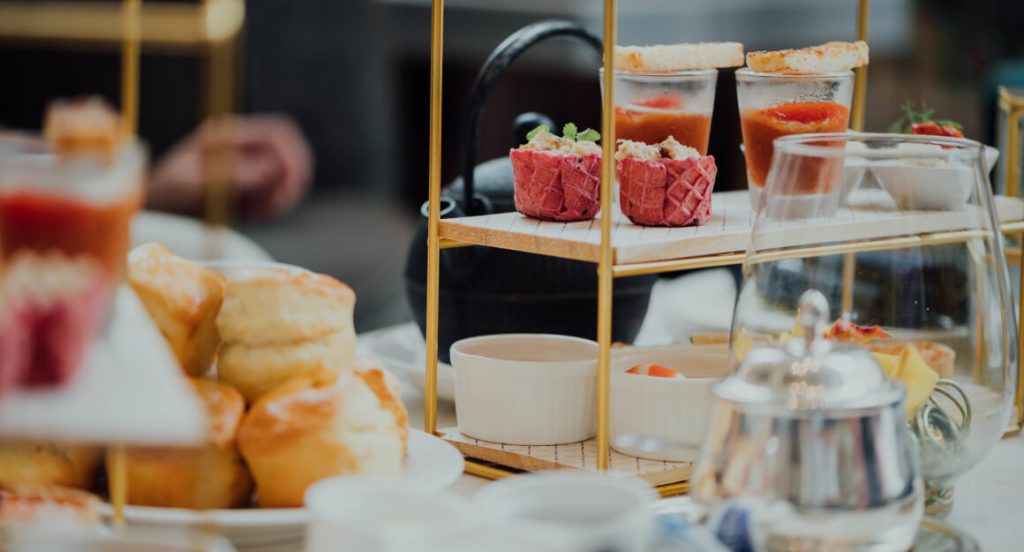
Larger and more structured — 50 to 500 guests, formal venue, often a hotel or a dedicated conference space. Food flows with the agenda: arrival coffee and pastries, mid-morning break, lunch buffet, afternoon break, sometimes an evening reception. Three timing principles matter most here: food ready before guests reach the break, enough variety so people who skipped lunch find what they need, and clean removal so the venue is ready for the next session.
Product launches and client events
Cocktail receptions, evening events, presentation-plus-dinner formats. Usually 50 to 200 guests. This is the format where branded presentation matters most — the food is part of how the company is positioning itself in front of clients or press. Themed receptions work particularly well at this format: an Italian evening for an anniversary launch, a Mexican-themed cocktail for a summer product reveal, an Asian-inspired tasting for a tech announcement.
Team off-sites and team-building events
Day-long or two-day formats at an external venue — a beach club, a villa rental in Agios Tychonas or Mouttagiaka, a mountain resort outside Limassol. The catering covers multiple meals across the day: breakfast or arrival coffee, lunch, afternoon snack, often dinner. Logistics here are different from a single-event booking: we plan the full day’s food sequence, not one meal.
Corporate celebrations and anniversaries
Company anniversaries, milestone announcements, retirement parties, and end-of-quarter celebrations. Mix of business and social register — more relaxed than a board meeting, more formal than a personal birthday. Mixed adult crowd, often with plus-ones.
End-of-year and holiday parties
December is peak corporate season. Christmas parties, New Year’s events, and end-of-year team dinners. These dates fill up early — booking from October is normal for the larger events. From Christmas through New Year’s Day, the calendar gets tight; we plan accordingly with clients who book in advance.
Partner events and external relationship events
Client appreciation dinners, partner roundtables, investor events, board dinners. Usually smaller (10 to 40 guests), often more formal, almost always with a defined dietary brief in advance. The expectations on service quality are highest at this format — these are the events that build or test long-term business relationships.
What food works at corporate events
Different B2B formats call for different food choices. A few practical principles based on what works most often:
For working lunches and business meetings
Food that doesn’t interrupt the conversation. Sharing platters, salads in party portions, finger food, light hot dishes. Keep plates manageable, keep volume controlled, keep the cleanup quick. Save the heavy items for evening events. Mors, lemonade, sparkling water, and coffee handle the drinks side.
For conferences and large-scale presentations
Buffet service over plated — guests pace themselves, the schedule absorbs delays, and dietary variety is visible. Tartlets, bruschetta, mini burgers, mini croissants, and platters move quickly through a 200-person break. For a sit-down lunch within a conference, salads in party portions plus a hot main and a side keep the schedule on track.
For evening receptions and product launches
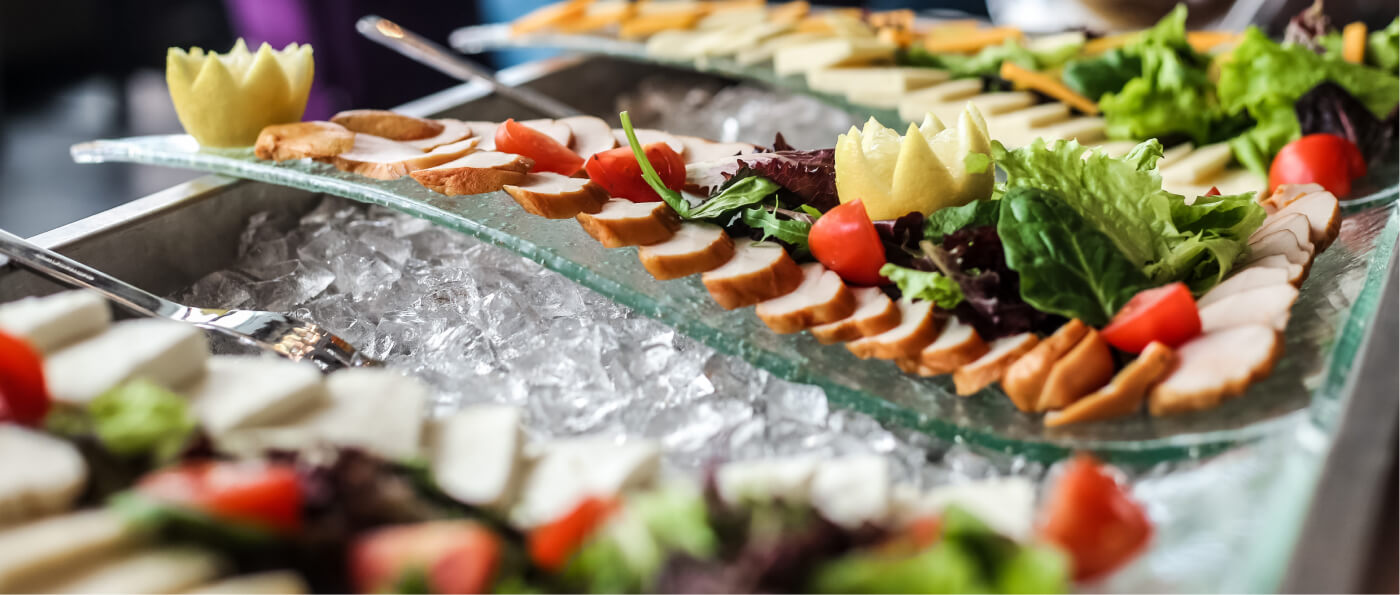
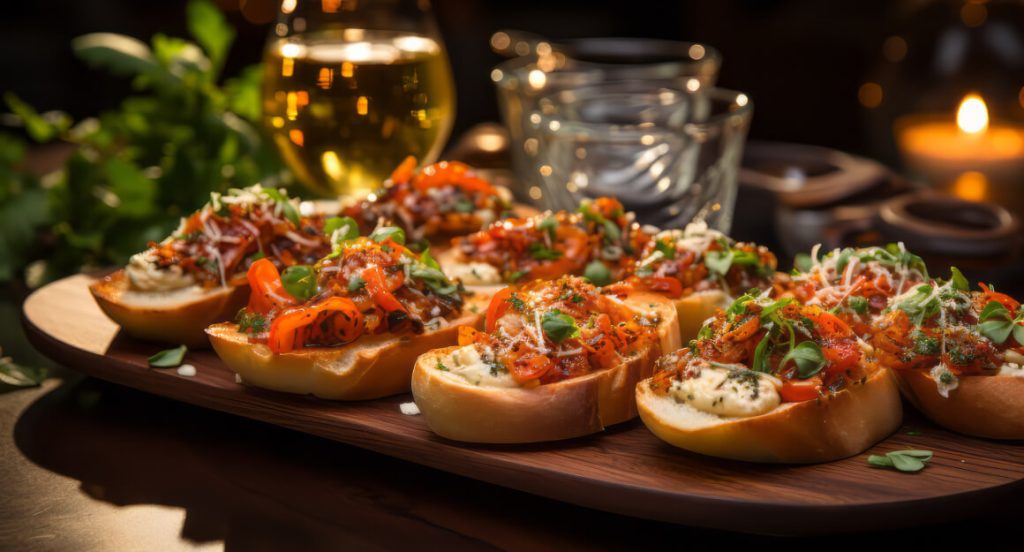
This is where finger food shines. Tartlets across the range (with salmon and red caviar, with mascarpone, with crab, with mushroom or chicken julienne), bruschetta (prosciutto and melon, smoked salmon, ricotta with truffle honey), mini burgers, Caprese bites, rolls, canapés. Hot meat or hot fish platters as centerpieces. Cold cheese, meat, and fruit platters for variety.
For themed events
The cuisine drives the menu, the presentation, and the décor. Our catering repertoire spans Eastern European, Italian, Indian, and Mexican — four full cuisine traditions, not a fusion mash-up. An Italian-themed launch can run on bruschetta, Caprese, salads, pasta, tiramisu. A Mexican-themed evening on guacamole tartlets, Asian-style shrimp, lula kebab adapted to the theme, and lighter drinks. Mention the theme at the quote stage.
For all-day team off-sites
Plan in segments rather than one menu. Arrival coffee with light pastries. Mid-morning fruit and light snacks. Lunch as a substantial buffet. Afternoon break with sweet items. Dinner is separate again if the day runs into the evening. Each segment has its own logic; trying to plan it all as one menu produces fatigue by 15:00.
Logistics: catering at an office vs. an external venue
The venue type changes the catering plan more than most clients expect. Two main cases:
Catering at the company’s office
The good: known logistics, building access usually straightforward, kitchen sometimes available for plating.
The constraints:
- Space. Office boardrooms and meeting rooms weren’t designed for catering setups. We plan the buffet or food table layout according to the room — sometimes a single table, sometimes a station setup if space allows.
- Power and equipment. Most offices have basic kitchen capacity (microwave, fridge, sometimes a small oven). For hot food at scale, we bring everything we need.
- Building access. Some Limassol office buildings have loading restrictions, freight elevator scheduling, or visitor sign-in processes. We confirm these with the booker during planning, so the team isn’t waiting at the entrance.
- Cleanup expectations. Offices need to be functional the next morning. We clean to a higher standard than a private home — the team that comes in on Monday should find no trace of Friday’s event.
Catering at an external venue (hotel, conference space, villa, beach club)
The good: more space, often a service area for staging.
The constraints:
- Coordination with the venue. Many Limassol venues have their own food and beverage policies, kitchen access rules, and load-in timing. We coordinate directly with the venue manager so the day works for both sides.
- Outdoor variables. Beach clubs and villa terraces are popular for summer corporate events, but they need wind, sun, and temperature planning. We adjust packaging and service style based on the venue.
- Equipment compatibility. Some venues require us to bring everything (tables, linens, service equipment); some have most things on-site. We confirm before the event.
For both cases, the booker’s job is to give us the full venue picture during planning. The clearer the brief, the smoother the day.
Dietary mix in corporate groups: a practical approach

This is where corporate catering most often goes wrong. The booker compiles a partial dietary list, the caterer builds the menu, and on the day, a guest discovers the only vegetarian option is a side salad. The fix is structural, not individual.
What we do:
- Build the menu so it works even with incomplete dietary information. A balanced catering spread covers vegetarian, gluten-free, lactose-free, and most allergens without anyone having to opt in. We don’t make these “special menus” — we make them part of the standard plan.
- Confirm specific allergies in writing. When the booker has known severe allergies (peanut, shellfish, etc.) in the group, we lock those in writing and brief the kitchen and service team specifically. We won’t guess on allergies.
- Label the buffet. For larger events, we put labels at the service line so guests can identify what’s vegetarian, what contains gluten, what contains common allergens. This is more useful than asking a server who took the order at 7am.
- Plan menus with built-in flexibility. We size the menu so it absorbs last-minute dietary changes — more vegetarian guests than the brief indicated, an allergy that surfaces on the day — without anyone going short. A small detail, no extra cost, prevents most last-minute issues.
For events where the company doesn’t know the guest list in detail (an open conference, a client mixer), this becomes more important — and we plan accordingly.
Long-term corporate partnerships
A meaningful share of our catering work is with companies that book regularly — weekly office lunches, monthly board meetings, quarterly events, recurring partner dinners. Long-term partnerships work differently from one-off bookings, and they save the client real time and budget.
What changes:
- You don’t re-brief us every time. After a few events, we know the company’s preferences, the regular dietary mix, the office layout, the service expectations. New bookings take less time to plan because the baseline is locked.
- Menu rotation. For recurring events, we vary the menu so the same team doesn’t see the same dishes month after month. Variety matters more for repeat catering than for one-offs.
- Pricing flexibility. Long-term corporate partnerships get pricing that reflects the volume. We discuss this directly at the partnership stage rather than applying a rigid discount table.
- Faster response, priority booking. For partnership clients, urgent bookings (a same-week board meeting, an unexpected client visit) get handled faster because we already know the brief.
- One point of contact. A dedicated person on our side handles all the company’s bookings, so the company isn’t re-explaining itself to a new manager every time.
If your company runs more than a few corporate events a year in Limassol or Cyprus, it’s worth talking about a partnership setup rather than booking event by event.
How invoicing and payment work for businesses
Standard B2B handling:
- Official invoices. Issued for every corporate booking, with company details, VAT registration if applicable to your business, and itemized service details.
- Payment methods. Bank transfer and card. Most corporate clients use a bank transfer.
- Deposit and balance. A deposit secures the booking; the balance is due before the event. For long-term partnership clients, monthly or per-event invoicing can be arranged.
- VAT and tax details. Confirmed at the quote stage based on your event and your company’s setup. We provide the documentation your accounting team needs.
- Fixed pricing upfront. What we quote is what you pay. No hidden fees, no surprise additions on the final invoice.
If your finance team has specific invoicing requirements — purchase orders, vendor registration, specific payment terms — flag them at the planning stage, and we’ll work with what your process needs.
Common questions about corporate catering in Limassol
How far in advance should I book a corporate event?
For working lunches and small meetings (under 20 guests): 2–3 business days is usually fine. For conferences, product launches, and events with over 50 guests: 2–4 weeks is comfortable. For December holiday parties: book by October. For long-term recurring catering, we set up the partnership first, and then bookings happen on a faster cycle.
Do you cater corporate events outside Limassol?
Yes. We cater across all of Cyprus — Paphos, Larnaca, Nicosia, Ayia Napa, and anywhere else on the island.
What’s the minimum guest count for a corporate event?
10 guests is the standard starting point for catering. Below that, our regular delivery service often handles team lunches more simply. Above 10, catering is usually the right channel.
Can you handle 200+ guest conferences and product launches?
Yes. Our standard envelope is for 10 to 500 guests, and conferences in that range are a regular part of our work. Larger than 500 — talk to us; we’ll be honest about whether we’re the right fit.
Do you provide service staff at the event?
Yes. Turnkey corporate catering includes professional service staff during the event — setup before, service through, and cleanup after.
Can you cater an all-day off-site or two-day event?
Yes. Multi-meal day events (arrival coffee, lunch, afternoon snack, dinner) are planned as a sequence. For two-day events, we coordinate across both days with the venue and the schedule.
Do you provide invoices with VAT for corporate clients?
Yes. Official invoices with all required documentation are issued for every corporate booking. VAT and tax details are confirmed at the quote stage.
Do you offer long-term partnership pricing?
Yes. For companies booking regularly (weekly office lunches, recurring meetings, monthly events), we set up partnerships with pricing that reflects the volume. Discuss it when you first reach out.
What if my event format changes between booking and the event date?
Tell us as soon as you know. Small changes (guest count, timing, a switched venue) are usually manageable. Larger changes need 24+ hours’ lead time so we can adjust the prep and the staffing.
What languages do you work in for corporate clients?
English, Russian, and Greek. Many corporate planning conversations in Limassol happen across two languages — we work in whichever language the booker is most comfortable with.
How do I get a quote?
Call +357 966 632 48, message on WhatsApp, or use the catering form on our catering page. Tell us the event date, guest count, venue, format, agenda if relevant, and any dietary notes. Our manager replies within an hour.
How to book corporate catering
For any corporate event in Limassol or across Cyprus:
- Call +357 966 632 48
- Message on WhatsApp
- Or use the “Get your catering quote” form on our catering page
What helps us send back a useful first quote:
- Event date and time
- Guest count (best estimate)
- Venue (address and type — office, hotel, villa, beach club, outdoor)
- Format (working lunch, buffet, cocktail reception, seated dinner, all-day)
- Agenda if relevant (coffee at 09:00, lunch at 13:00, etc.)
- Dietary notes — known restrictions, allergies, vegetarian count, if you have it
- Theme, if any (Italian evening, Mexican fiesta, branded presentation, etc.)
- Budget range, if you have one
The clearer the brief, the faster the quote, and the closer the first proposal is to what you actually need.
We’ve been catering Limassol businesses for six years from our own kitchen, with our own delivery team. Fresh-cooked, turnkey, island-wide.
Popular articles